


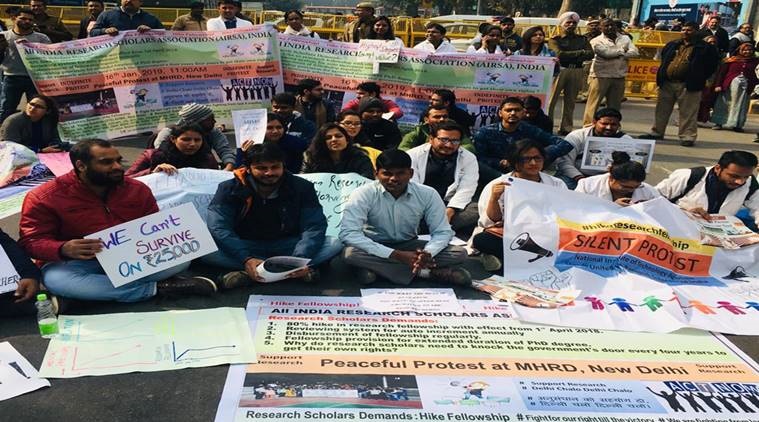
India’s booming interest in doctoral research is increasingly clashing with a stark reality: most UGC-NET qualified Ph.D. scholars lack adequate fellowship support, creating a funding and academic crisis that affects students across states including West Bengal.
The University Grants Commission’s National Eligibility Test (UGC-NET) is a key gateway for securing Junior Research Fellowships (JRF) — essential stipends that enable full-time research without financial worry. Yet, despite a recent surge in NET qualifiers, only a small fraction of candidates actually receive JRF funding. In the June 2025 cycle, over 1.28 lakh candidates became eligible for Ph.D. admissions through UGC-NET, but just around 5,269 obtained JRF status — roughly 4 % of qualifiers. This leaves the majority of Ph.D. aspirants without the guaranteed financial support they need, forcing many to take up part-time teaching or paid work instead of focusing on research. The Times of India
This imbalance stems from structural limits in the fellowship system. Traditionally, the UGC capped the JRF awards at the top 6 % per subject/category regardless of how many qualified candidates there are. With a growing postgraduate population and rising Ph.D. interest under the National Education Policy (NEP) 2020, the fellowship support framework has failed to keep pace. Budgetary constraints at UGC and delayed research funding initiatives like the Anusandhan National Research Foundation have further compounded the issue. The Times of India
For those without JRF, the alternative is the non-NET fellowship, which continues to be insufficient. Many Ph.D. scholars receive a nominal stipend of ₹8,000 per month — a figure largely unchanged for over a decade — which barely covers basic living costs, let alone research expenses. This stipend discrepancy disproportionately affects students from economically weaker backgrounds and socially marginalised communities, undermining inclusivity in research. Careers360
The situation is particularly acute in West Bengal, where research students have reported extended delays and non-receipt of fellowship disbursements. Scholars at institutions such as Visva-Bharati University have gone for months without funding, adversely impacting both their academic progress and personal wellbeing. These delays have forced some to borrow money or drop out of Ph.D. programmes altogether. TwoCircles.net
In addition to funding shortages, administrative challenges have worsened the crisis. For example, some state universities have paused or delayed Ph.D. admissions or coursework cycles, which can result in the suspension of stipend eligibility and further academic setbacks. Telegraph India
Experts argue that without meaningful reforms in fellowship allocation — such as raising stipend amounts, expanding JRF slots, and ensuring timely disbursement — the quality of India’s research ecosystem could be compromised. Many promising scholars might be pushed towards teaching jobs or overseas opportunities simply due to financial insecurity.
This funding shortfall and administrative inertia not only threatens individual doctoral journeys but also the broader ambitions of India’s higher education strategy. For the country to build a robust research culture, ensuring that every qualified Ph.D. scholar receives dependable financial support is increasingly seen as imperative.
Note: Content and images are for informational use only. For any concerns, contact us at info@rajasthaninews.com.

Previous Post

Next Post
"हाईकोर्ट ने प्राइव...
Related Post

_1787583414.jpg)
_1788282058.png)
_1788281507.png)
_1788280999.png)

_1788280346.png)